

The Problem Most Companies Cannot Name
And why it costs organizations millions.

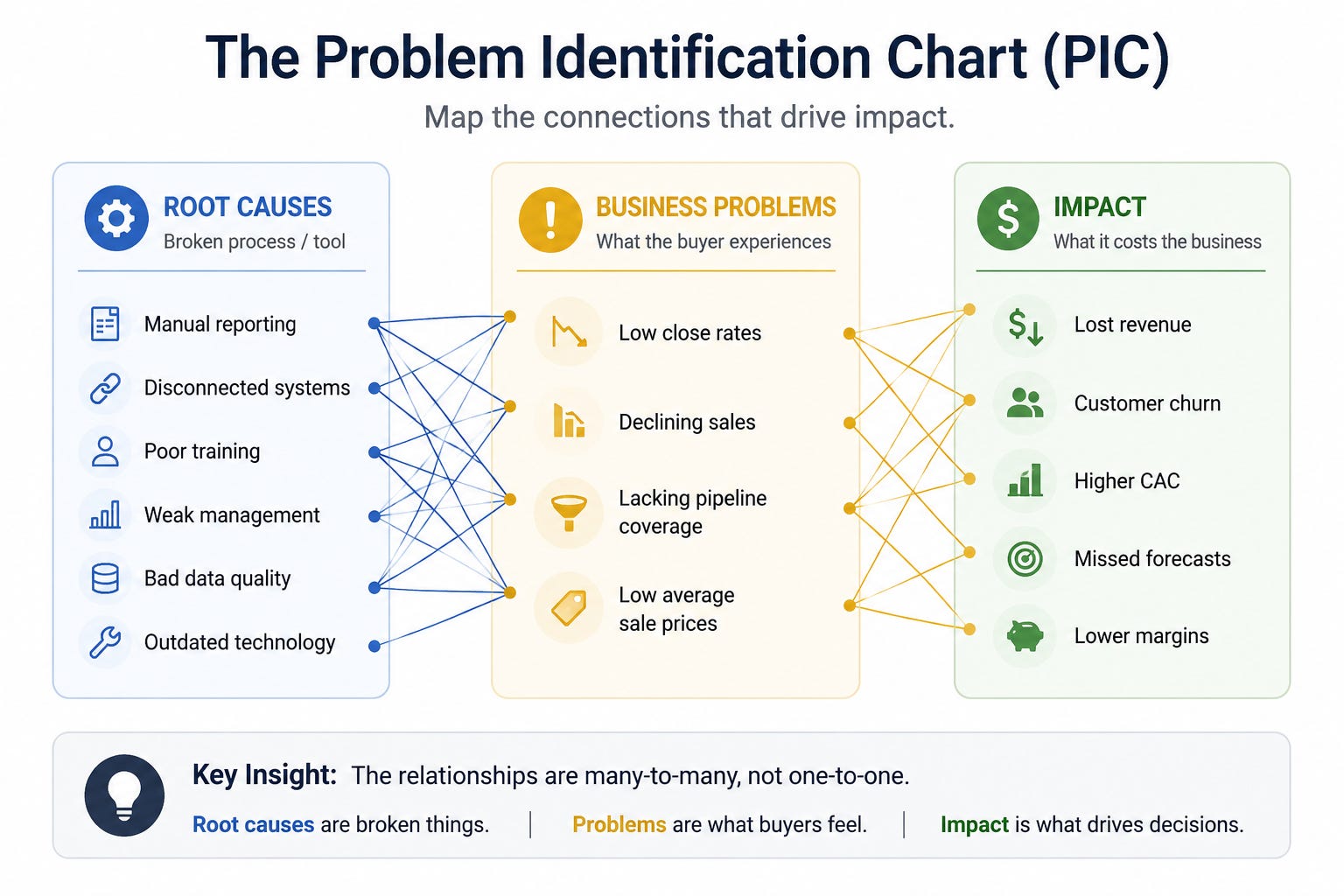
A few weeks ago I was in a workshop with the executive team of a mid-market software company. They were a sharp group. The CEO had been an operator for thirty years. The CRO had run revenue at three different scaled companies. The CMO had built brands I’d recognize. The product leader had run engineering at one of the most respected platforms in the space. The room knew its business cold. Or thought it did.
I asked them a simple question. What problem do you solve.
The CEO went first. He gave me the elevator pitch. We help mid-market companies streamline their revenue operations through a unified platform. The CRO nodded. Right, we help companies get a single source of truth on pipeline, deal stage, and forecast. The CMO took her swing. We help revenue leaders make better decisions with real-time data. The product leader, who I’d had dinner with the night before and who I knew was sharper than this answer, said something about consolidating the GTM tech stack.
I waited. Nobody noticed they hadn’t actually answered my question.
I’d asked what problem they solve. They told me, four different ways, what they DO. The verb was “help” but the structure was a product description in every answer. Not one of them named a single business problem the buyer would recognize as theirs.
This is not a story about a bad executive team. This is a story about a normal one. We’ve run this exercise with hundreds of companies and the result is almost always the same. The opening answer is product-centric. We help companies do X. We provide Y. We enable Z. That answer is not a problem. It’s an output disguised as a problem because the verb sounds like one.
Then I push.
After the first round, I tell the room, that’s not a problem. That’s what your product does. Tell me what’s actually broken in the buyer’s business that your product fixes. The room rallies. The CEO comes back, OK, we help companies who lack visibility across their revenue stack. The CRO, we help companies stuck with manual reporting cycles. The CMO, we help leaders who are drowning in disparate data sources. The product leader, we help companies whose go-to-market tools don’t talk to each other.
Better answers, structurally. Worse answers, taxonomically.
Because none of those are problems either. Lack of visibility. Manual reporting. Disparate data. Tools that don’t integrate. Those are root causes. A root cause is always a broken process or a broken tool. Never a business problem. Never an impact. It is the mechanism that produces both.
Take a warehouse as the cleanest illustration. Sit with the business problem of high returns. What’s producing it? Could be a manual picking process. Could be untrained warehouse staff. Could be poor SKU labeling. Could be no quality check before the box leaves the dock. Could be an outdated WMS that doesn’t validate orders against the SKU master. Five different broken things, all capable of producing the same business problem. The impacts downstream are similar but distinct. Reduced margins because every return absorbs labor and return shipping. Customer churn because customers fed up with order errors take their volume elsewhere. Higher CAC because winning a customer back costs more than keeping them in the first place.
Now run it the other direction. Take one of those root causes, the manual picking process. What business problems can it produce? High returns, yes. Also customer churn from repeated order errors. Lost retail partner contracts because shipment errors trigger compliance breaches on delivery SLAs. Inventory shrinkage running above benchmark because pick mistakes cascade into inaccurate stock counts. Missed peak season revenue because the process can’t absorb volume spikes. One broken process, five distinct business problems. Each with its own impact line.
This is the part most people miss when they try to draw a PIC. The relationship between the three columns is many-to-many, not one-to-one. A single business problem typically has a half-dozen root causes feeding it. A single root cause can produce several business problems. The PIC is not a list. It is a map of the connections between layers. Building it requires the leadership team to actually trace every connection, not just guess at one row and move on.
Look at ASG’s own PIC for a moment. The four business problems we sell against are low close rates, declining sales, lacking pipeline coverage, and low average sale prices. Each one is a recognizable condition a revenue leader would name. Each one has a stack of root causes feeding it. Take low close rates. The root causes that produce it, in our experience across hundreds of revenue orgs, include weak sales team, lack of training, poor sales enablement, poor deal strategies, poor sales management, real product issues, lack of understanding of target customer, poor marketing, wrong target marketing. Nine root causes for one problem. Several of those same root causes also feed our other three business problems. Lack of training shows up under declining sales. Poor sales management shows up under declining sales. The connections cross-link. That cross-linking is why fixing one root cause can sometimes shift multiple problems at once, and why missing one can leave a problem untouched no matter how many other root causes you address.
Map this for your own business and the work gets clear. Three columns. Three definitions. Many-to-many connections between them. Most companies cannot articulate any of it. Until they do the work.
**The Problem Is** the company that cannot name the problems it solves cannot teach its sellers to find those problems in a buyer’s business. Because there is no shared definition to find against.
What ends up happening, instead, is what we see in every dysfunctional sales org. Reps go into discovery and they ask product questions. How are you doing this today? How many of these do you have? Who else is involved? They take the answers and pattern-match to features. The buyer mentions a manual reporting cycle, the rep says, our platform automates that. Done. Move to demo. Move to proposal. Three weeks later the buyer goes dark and nobody can figure out why.
The reason is simple. The rep solved a root cause. They never named the business problem the root cause was producing. They never quantified the impact. The buyer never got to the place where the cost of inaction exceeded the cost of action. Because that math gets done at the impact layer, not the root cause layer. And the rep never got there.
There are two findings from our buyer research that should land hard for any revenue leader reading this.
The first. 37% of B2B buyers told us the number one reason their last deal stalled was the rep didn’t understand the problem. Number one. Ahead of budget. Ahead of competition. Ahead of timing. Discovery quality, in the buyer’s own words, is the single biggest predictor of whether the deal lives or dies.
The second is harder. 48% of B2B buyers told us they had bought the wrong product at least once because nobody understood the problem they were trying to solve. Read that twice. Almost half of B2B buyers, in survey, say they have spent budget on a product that did not solve their business problem because the rep on the other side of the table did not diagnose what was actually broken. That is not a stalled deal. That is a closed deal that produced a churn customer, a damaged relationship, and a dollar of revenue that costs you more than it earned once you account for the renewal that’s not coming.
Bad problem identification kills you twice. Once at the top, where 37% of your deals never close because the rep can’t articulate the buyer’s problem. Again at the bottom, where almost half of the deals you do close turn out to be the wrong solution to the wrong problem and churn out within a cycle or two. Neither failure shows up as “we sell the wrong product.” Both are diagnostic failures upstream of the close.
If 37% of your deals stall on problem misunderstanding and 48% of the rest were sold to the wrong fit, the issue is not pipeline. It is not closing skills. It is not a discounting problem. It is that the document your rep was supposed to learn the problem from does not exist in your company.
This is the part that should sting if you’re reading this and your team runs Gap Selling.
We have clients who tell us they’re a Gap Selling shop. They’ve read the book. They run the workshops. They reference current state and future state. They have it on the wall. They have not built a PIC. Not even an attempted one. They believe Gap Selling is the philosophy of “find the gap between what is and what they want and sell to it” and that the methodology stops there. It does not stop there.
The Problem Identification Chart is the operating layer that makes Gap Selling work. Three columns. Problem, Impact, Root Cause. Defined precisely, distinguished rigorously, mapped many-to-many for the specific ICP your company sells to. Without that document, the philosophy floats. Reps run into discovery armed with vibes. They come back with vibes. The deal review is a vibe check. The methodology produces no compounding effect because there is no shared definition for the team to compound against.
You can read every book. You can attend every workshop. You can certify every rep. If you have not, as a leadership team, sat down for the weeks it actually takes to build the PIC, you are running the philosophy without the architecture. The architecture is what produces results.
People don’t buy to fix root causes. They buy to fix business problems. If your rep cannot articulate the business problem in the buyer’s own language, the buyer doesn’t recognize themselves in the conversation. The product becomes one of three quotes. Price becomes the differentiator. The deal goes to a cheaper option, or to no decision, or to a budget freeze.
All of that traces back to the PIC the company never built.
**The Point** is there is no shortcut to the PIC. It is the most expensive document a company will ever produce in terms of time and executive attention. We have never had a company complete it in less than several weeks of actual work, with the right people in the room, willing to argue, willing to throw out the first draft, willing to admit that what they thought they sold is not actually the problem they solve.
Most companies refuse to do this work. They want the methodology certification. They want the workshop. They want the wall poster with “find the gap” on it. They do not want to sit in a room for three weeks and argue with their CMO about what counts as a business problem versus an impact versus a root cause, and how the connections between them actually run.
The companies that do it have a different sales motion six months later. The reps run discovery against a real definition. The deal reviews inspect against a real definition. The forecast is built on real definition. The competitor’s reps are still pattern-matching to features. Yours are diagnosing.
This is the work. There is no version of Gap Selling, or any other problem-centric methodology, that produces compounding results without it.
If your team cannot, today, name the business problems your buyer experiences when they do not have your product, separate from the broken processes that produce them, separate from the downstream impacts each problem creates, with the connections mapped between layers, you do not have a methodology.
You have a vocabulary you have not earned.
Build the PIC. Or stop calling yourself problem-centric.
How does this have no comments? A straight master class in building an org that understands how to help your buyer at every turn - not one that leads with….product.
We out here changing the world with every PIC we compete with a team.