

When The Software Got Cheap
Let the blood bath commence.

I was on a call with a CRO last month, mid-March, who was visibly trying not to panic. He runs revenue at a mid-market SaaS company, the kind that grew 40% last year and was supposed to grow 35% this year. The board call had been the day before. The board had asked him a question he wasn’t ready for.
“What part of your team can be replaced by Claude Cowork?”
He told me he sat there for a beat. He was prepared for questions about pipeline coverage. He’d built a deck on win rates. He had a story about the new SDR program. He had, as every good CRO does, a contingency plan for a softer Q2.
He did not have an answer for that question. Nobody on his leadership team did.
The question wasn’t rhetorical. The board had been reading the same headlines everyone had. Anthropic launched Claude Cowork in January. Open-source plugins for Sales, Legal, Finance, Marketing, Data Analysis. Two trillion dollars of SaaS market cap evaporated by April. Wait, scratch that word, two trillion dollars wiped off in four months. The board wasn’t asking him as a hypothetical. They were asking him because they had already started cutting their software budgets and wanted to know which of his people they could cut next.
He flew home that night thinking about the question. He’d been a CRO for eleven years. He’d never been asked it before in those terms. He told me, on our call, that the part that scared him wasn’t the headcount question. It was that he didn’t have a framework for answering it. He didn’t know which roles on his team did work that AI couldn’t do. He didn’t actually know what his reps did all day, in the deep sense. He knew the activity. He didn’t know the work.
I think a lot of CROs are about to have that same conversation. Most of them aren’t going to be ready either.
**The Problem Is** the SaaS layer and the rep layer were doing the same thing for years, and we didn’t notice because the spreadsheet hid it.
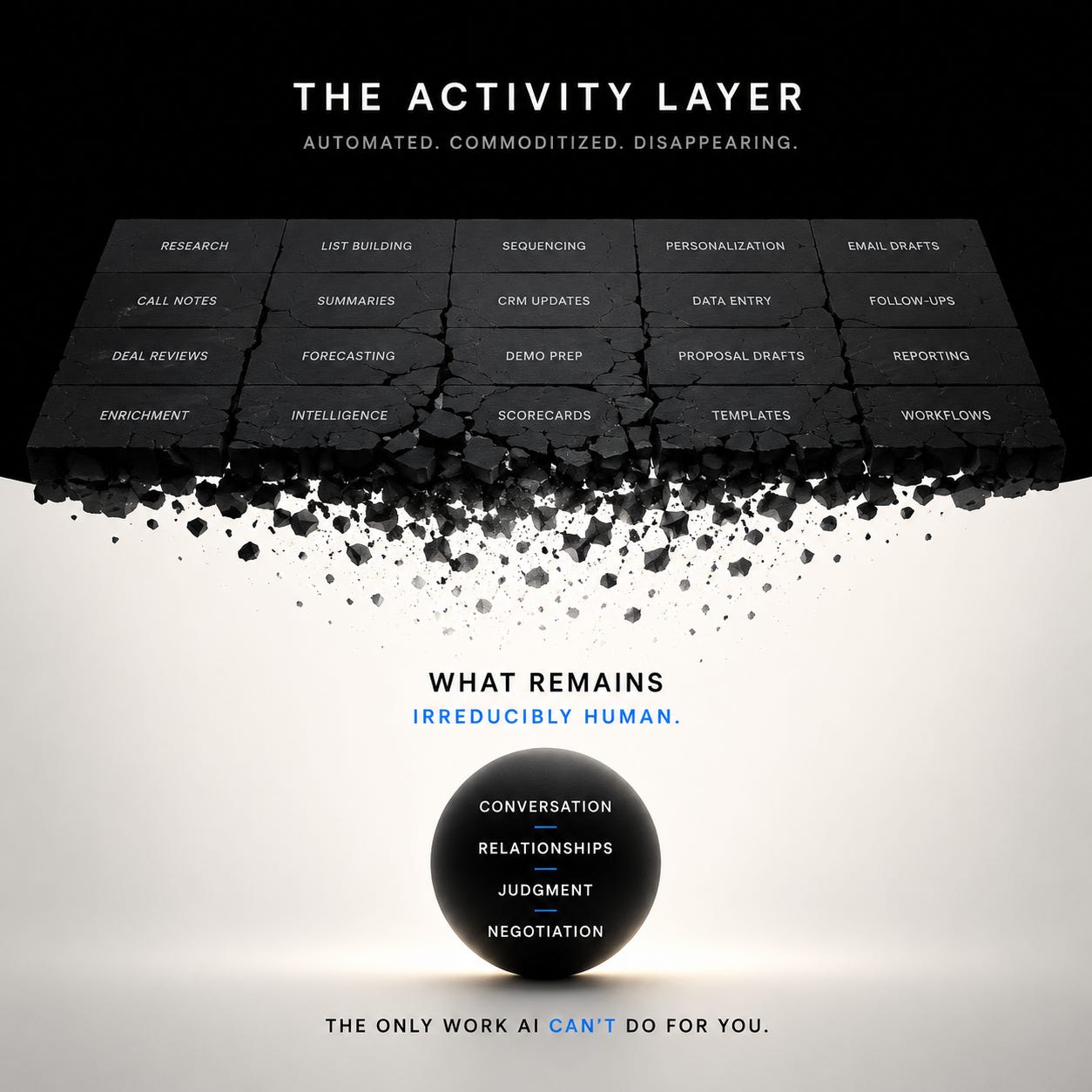
Think about what your average rep actually does in a week. Research accounts. Build target lists. Sequence outbound. Personalize messages. Take a discovery call. Take notes. Write a follow-up email. Build a one-pager. Update Salesforce. Pull a forecast number. Write a deal review. Prep for a manager 1:1. Run a demo. Send a recap. Loop in a stakeholder. Draft a proposal. Follow up after a meeting. Repeat.
Now look at that list and circle the parts that require a human in the loop. Be honest.
Maybe four items. Discovery. Demo. Stakeholder management. Proposal negotiation. The rest is information assembly, summarization, message drafting, data entry, and follow-through. Every single one of those activities can be handled by an agentic AI right now, today, with current tooling. Not in two years. Now. Claude Cowork is just the brand name.
The reason it took the market this long to price it in is that for the last decade, the SaaS industry sold the rep team a thousand tools to do those activities better. Outreach to sequence. Gong to record. Clari to forecast. Salesloft to coordinate. ZoomInfo to research. Apollo to enrich. Lavender to write. Crystal to personalize. Each tool extracted a layer of work from the rep and moved it onto a software seat. The rep was supposed to be left with the high-value parts.
That isn’t what happened. The rep, in most cases, became a curator of automated artifacts. They reviewed the AI-drafted email. They edited the AI-summarized call notes. They dragged the AI-scored deal up or down a stage. They ran demos that increasingly looked like a deck the marketing team built. The “high-value” work compressed because the easy work expanded to fill the calendar.
Then Claude Cowork showed up and said, fine, we’ll just do all of that for you, no per-seat license, plug into your tools, drop the artifacts in a folder. The CFO ran the math on the unit cost and the answer was a heart attack. A trillion-and-a-half dollars of SaaS valuation, in four months, was the market saying out loud what every CFO already knew. The intermediating layer between the rep and the actual selling work doesn’t need to be that expensive. It might not need to be there at all.
What the market hasn’t priced in yet is that the rep layer, in most companies, is also expensive in a way that doesn’t pencil once the tools collapse.
Walk through it. If the AI handles research, sequencing, summarization, follow-through, and CRM hygiene, what’s the rep doing? If the answer is “selling,” fine. Show me what selling looks like in practice when you strip the activity out. Most CROs can’t.
Because what they call selling is, in practice, mostly the activity layer. The rep’s day is built around tasks. Take away the tasks and a lot of reps don’t have anything left to do that the company can clearly point at. The discovery call is fifteen minutes. The demo is thirty. The stakeholder coffee is forty-five. That’s an hour and a half of actual selling on a good day, surrounded by hours of activity that, two years from now, no human is going to be assigned to.
This is the part nobody at SaaStr next week is going to want to talk about. The bifurcation isn’t between AI and humans. It’s between reps who can do the irreducibly human work, and reps who built a career on the activity layer.
The first group is going to be the most valuable employees these companies have ever had. The second group is going to be the layoff line in the Q4 board deck.
I had this conversation with a head of enablement two weeks ago. She said the quiet part out loud. “We’ve been training reps on tools for eight years. We trained them to be good at the activity. We never really trained them to be good at the conversation. Now the activity is going to be free, and the conversation is what we’re going to need them to do, and they’re not very good at it.”
That’s the gap. That’s the entire crisis sitting under the SaaS sell-off.
The AI isn’t replacing the seller. The AI is exposing what the seller was actually doing.
If your reps were running a real diagnostic conversation with buyers, asking precise questions about broken business processes, helping the buyer see a problem they hadn’t fully articulated, quantifying the cost of inaction in dollars per month, building consensus across stakeholders who started the conversation with different versions of the truth, holding the room long enough that the buyer chose action over the safety of doing nothing, then the AI tooling around them is just a productivity multiplier. They get to do more of that real work because the noise gets handled by Claude.
If your reps were curating templated outreach, summarizing notes, updating fields, and pushing deals through a stage gate they didn’t really earn, then the AI isn’t a multiplier. It’s a substitute. And the math the CFO is running right now will arrive at that conclusion well before the end of this year.
Most companies are in the second category. Not all. But most.
**The Point** is this is the moment the industry stops getting away with confusing activity for selling.
For twenty years, the SaaS economy and the sales economy reinforced each other. SaaS sold tools that automated rep activity. Reps learned to manage the tools. Quotas got hit, sometimes, mostly because there was enough macro tailwind to forgive the inefficiency. Methodologies got bought and shelved because the activity layer absorbed the energy that should have gone to building real selling skill. The org chart got bloated with layers of revenue ops, sales ops, enablement, and revenue intelligence to manage the tools the reps used to manage the activity. Every quarter, the headcount went up and so did the revenue, and the assumption was that those two things were causally related.
They weren’t, mostly. The macro was. Now the macro turned, the AI showed up, and the question on the table is whether the people you have on the floor can do the actual work, with the AI handling the rest.
The CRO I was talking to last month didn’t have an answer because he’d never been forced to ask. None of us had. The system was designed to obscure the question. Now the system is collapsing fast enough that the question is in front of every revenue leader at once.
Which of your reps can do the irreducibly human work? Have you ever, on purpose, watched them do it? Have you ever defined what good looks like in that work, in operational terms specific enough that you could grade a call against it?
If you can’t answer those questions, you’re not behind on AI. You’re behind on selling.
The two trillion dollars the market wiped off SaaS this spring is, in a strange way, the most useful thing that’s happened to the sales profession in a decade. It’s forcing a question we’d been avoiding. The CRO who answers it now is going to be running a much smaller, much sharper, much more valuable team in 2027. The CRO who doesn’t is going to be on a board call no one wants to be on.
What does your rep do that AI can’t? You should know the answer by Q3.
Because the board is going to ask.
Man...I hope this is a sign of things to come. I came to find you via your blog posts, and if this means you are going to be doing more writing again, I can't wait!